
If we lived in a perfectly natural world — or a naturally perfect one, perhaps without the human species — every single day billions of living beings would be eaten by other living beings. So what? Well, I don’t get off the hook by saying “it’s nature”: the real question, for me, isn’t whether life feeds on other life. It’s how.
A planet that eats itself
On this planet, life is quite literally made of other life: a web of dependencies in which no one — least of all us — really sits at the centre. It’s the idea the Italian plant scientist Stefano Mancuso has been putting forward for years in his books (The Nation of Plants) and in his TED talk: we depend entirely on the rest of the living world, starting with plants.
Everything we eat comes from the plant world, the oxygen we breathe…
Stefano Mancuso (interview, Altreconomia)
If that’s true, the only thing we actually have any say over isn’t living or dying: it’s the quality of that passage. How we live, and how we die.
Me, almost vegetarian (blame my hens)
I’m almost vegetarian. Some days, maybe, almost vegan. “Almost”, because my hens — which live very well — lay their eggs whether I want them to or not, and throwing them out wouldn’t help anyone. So I eat their eggs, very little dairy and cheese, and no bought meat. I’ll come back to cured meats in a moment: there it’s more a matter of health than ethics. Sorry, farmers.
In practice, at our house:
- eggs from our hens: yes, obviously;
- bought meat: no;
- cured meats: no (for health more than principle);
- dairy and cheese: very little, and local;
- meat from our own animals: yes, in moderation.
And the animals we raise?
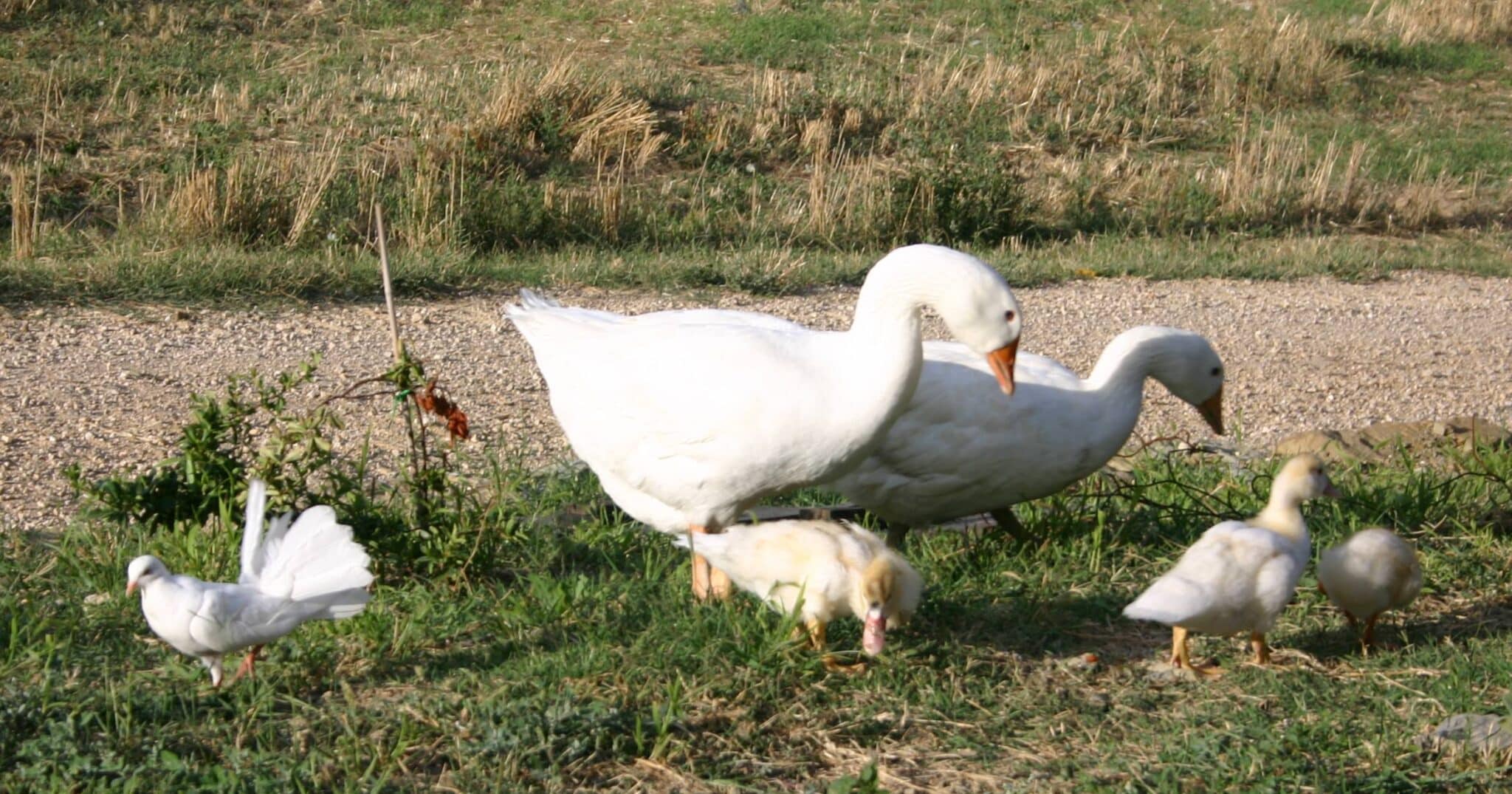
Our animals live well, eat well, and get their spells of freedom out on the grass. In the evening, though, they have to come in: foxes, weasels, stone martens and even crows would make a massacre. They have to live too, of course — but our hens and ducks would beg to differ on that point. It’s the “how you live” applied to the henhouse: a door shut at night so they can enjoy the grass by day.
Why I don’t buy meat
It’s not ideology: it’s that I know how most farms work. The footage was brought home by the undercover investigations of Essere Animali, an Italian animal-welfare organisation — images that have aired more than once on Report, the investigative programme on Italy’s public broadcaster RAI 3 — and the documentary Food for Profit by journalist Giulia Innocenzi showed that, in intensive farming, certain conditions are the rule and not the exception. You can’t tar everyone with the same brush — there are serious, decent farmers out there — but the abuses in the sector are too many, and as a consumer I have no way of knowing how the animal in the supermarket fridge lived, or how it died.
We eat too much meat, and that makes everything worse
In Italy we’re at well over 70 kg of meat per person per year. A lot. And the more meat we demand, the more producers have to churn out, compete on price and cut corners on how animals are raised: quality drops, animal welfare vanishes, and sometimes the bill comes back to us as our own health. It’s not just an impression: the WHO classifies processed meat as carcinogenic to humans (Group 1) and estimates that every 50 g of processed meat a day raises the risk of colorectal cancer by about 18%; red meat is probably carcinogenic (Group 2A). One clarification, because people often get this wrong: Group 1 means the evidence is solid, not that a slice of salami equals a cigarette. Which is exactly why, with cured meats, for me it’s mainly a health question.
I don’t want to become a zealot
I stand by my view, and by my near-veganism. But a zealot, no: I eat the meat of the animals we raise ourselves — because I know how they live — and if I happen to taste a local speciality, I don’t think the world will end over the meat I eat. It just won’t be my first choice any more. And yes, I already know: ever seen a perfectly vegetarian dog or cat? Exactly. To each their own nature; mine, at least a small piece of it, I get to choose.
So, what about the agriturismo?
We try to be consistent at the table, too. To our guests we serve only meat we’ve produced ourselves — because we know its life and where it comes from — and a little local cheese. No cured meats, sorry. If you’d like to see how that plays out on the plate, there’s our tasting menu. Because in the end, if life is made of life, the least we can do is take care of the how.
The questions we get asked most
No: we eat our own animals’ meat, in moderation. Let’s say almost vegetarian.
Because we serve only our own, whose life and origin we know. It’s the how, not the whether.
They come from our hens, which lay them anyway. Throwing them away would make no sense.
No — more for health than for ethics.
Of course, and gladly! We just need to know in advance. Elena also makes excellent vegan, dairy-free cheeses — sometimes you’ll find those on the menu too.